

Progression and suggestions
Every exercise gets a suggested weight and target for its next session, with no spreadsheets. A suggestion is only ever a suggestion: type another weight and the app follows what you really lifted.
What it reads
Section titled “What it reads”The app judges your work sets at the top weight from the last time you did the same rep range of that exercise. It counts reps and reps in reserve (RIR) together, so 11 reps with 1 in reserve is as good as 10 reps with 2 in reserve.
It also keeps one strength estimate for each exercise: roughly the most you could lift once, worked out from your sets of 12 reps or fewer. Machines and cables have an estimate for each machine, since their stacks don’t compare, and Squat and Deadlift have one for each bar.
An exercise with no history gets no suggestion until you’ve logged its first set.
The rules
Section titled “The rules”| What happened last time | What the app suggests |
|---|---|
| Every set reached the top of the range at the target RIR | The next weight your equipment has |
| In the range, short of the top | Same weight, one more rep |
| One rep short of the bottom | Same weight |
| Two or more reps short | One step down |
| The next weight is too big a jump | Same weight, one more rep |
| A deload week | Last time’s weight, at an easier target |
With a fixed rep target, beating it by one rep moves the weight up. When a block changes the rep range, the weight comes from your estimate, marked “estimated, check it on the first set”.
Weights are always ones you can load. The app knows each machine’s stack and your gym’s plates and dumbbells, so it never suggests a number your equipment can’t make.
During a session
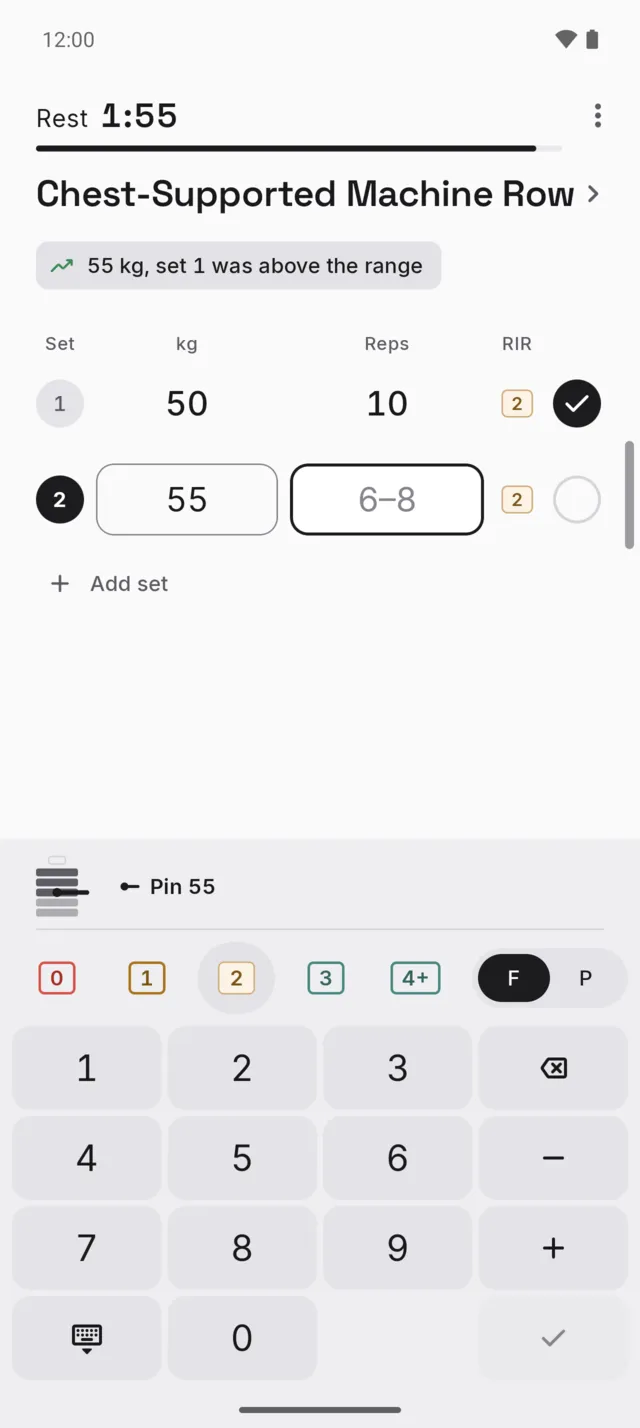
Section titled “During a session”The next set’s weight follows the gap between your target and the RIR you logged, about 5% for each point of RIR and at most 10%.
Why it says what it says
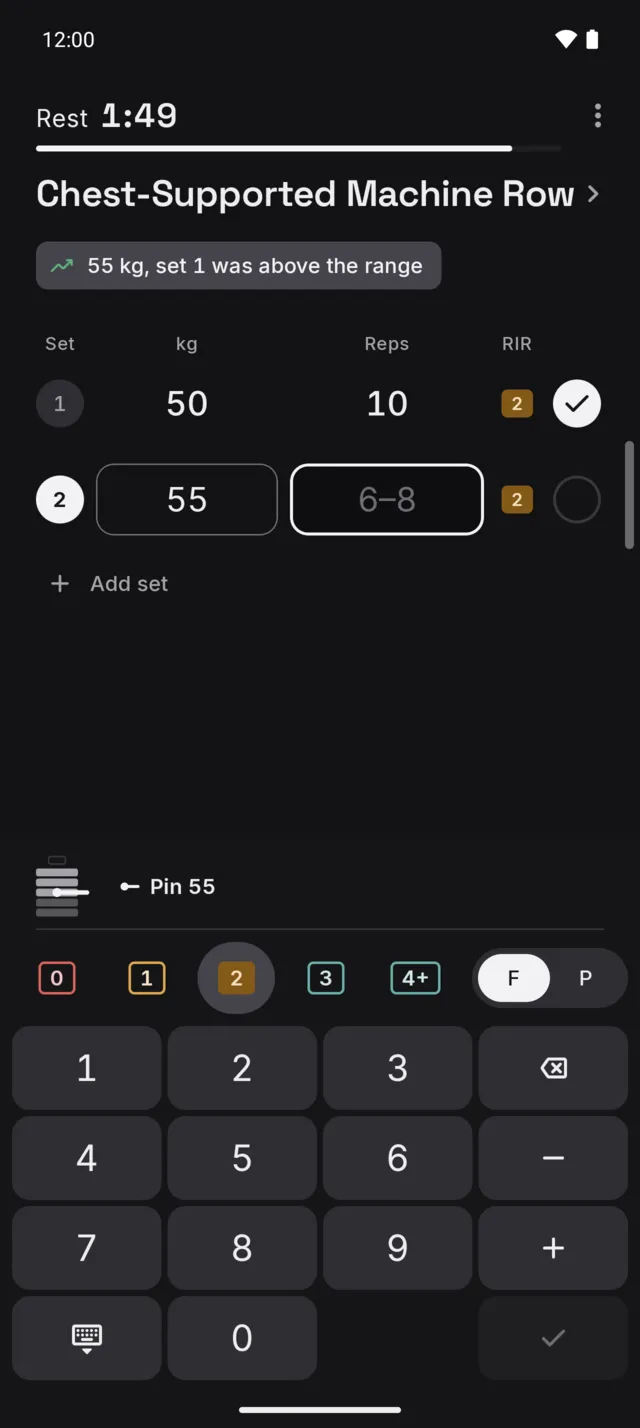
Section titled “Why it says what it says”Under the exercise’s name, a short line gives the reason: “Up to 62.5 kg, you topped the range” or “Stay at 40 kg, you were one rep short”. Tap it to see last time’s sets.
Deloads, easy weeks and Changes
Section titled “Deloads, easy weeks and Changes”A deload week never lowers your estimate, and the app doesn’t step the weight down after one. With training days set, after two or more weeks with no training the first week back is an easy week: one set fewer, one more rep in reserve and no techniques. A coach’s Change, such as 10% lighter after time off, applies on top of the suggestion for as long as it lasts.
Goals and records
Section titled “Goals and records”Set a lift goal for an exercise’s estimate from its trend in History → Progress, with a date if you like. A goal shows how far you are; it never changes your program or your suggestions. Goals are for free weights and weighted bodyweight exercises.
A set that beats your earlier ones is marked as a record: a new best estimate, or more reps than before at a weight you’ve lifted.